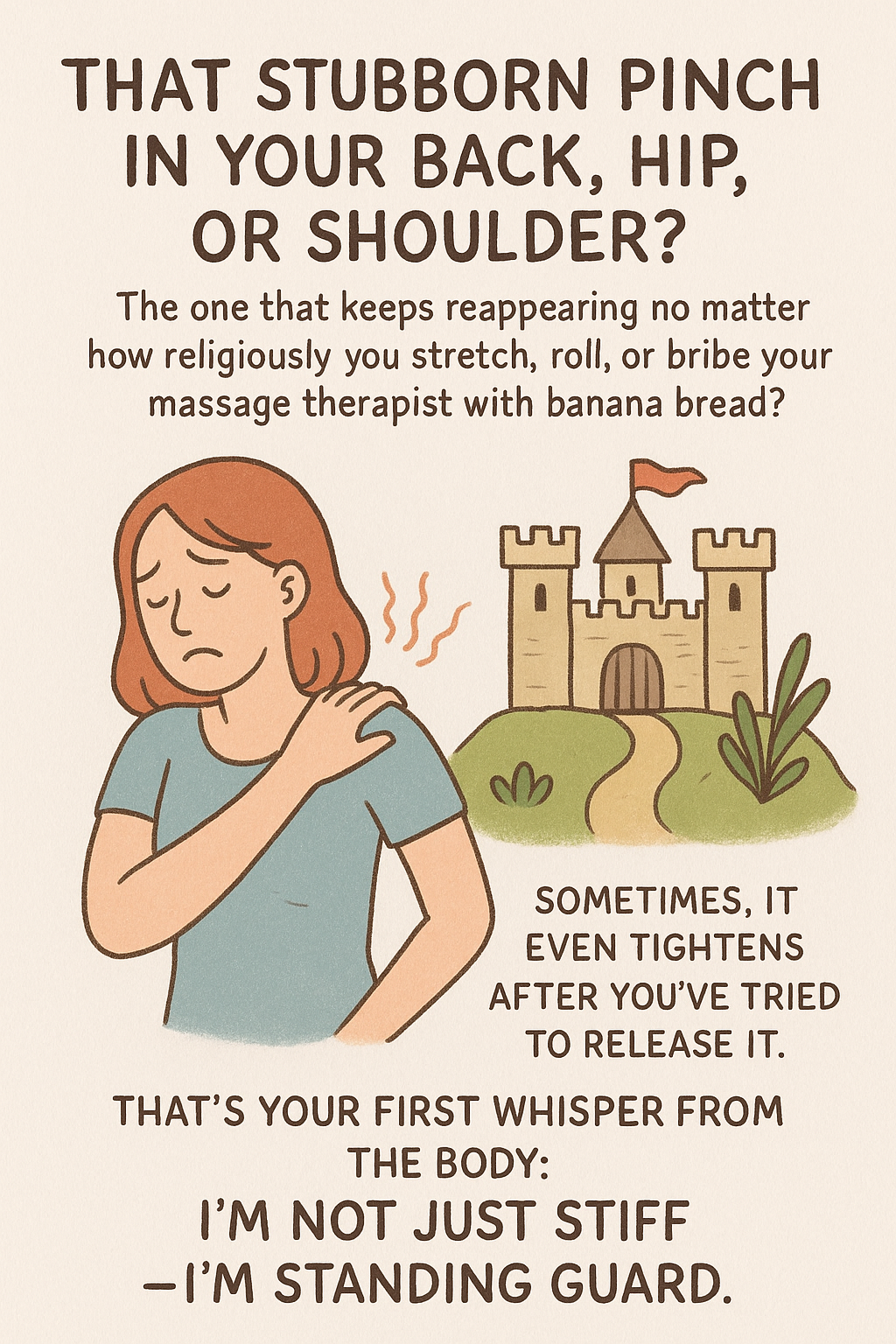
That stubborn pinch in your back, hip, or shoulder? The one that keeps reappearing no matter how religiously you stretch, roll, or bribe your massage therapist with banana bread?
Sometimes, it even tightens after you’ve tried to release it. That’s your first whisper from the body: I’m not just stiff — I’m standing guard.
Your body as the gatekeeper of your castle
Your nervous system is like a watchtower guard in a medieval castle. It’s not just scanning the horizon for invaders; it’s checking the drawbridge, testing the hinges, listening for creaks in the walls. If it finds a weak point — an old injury, a joint that feels wobbly, a muscle group that can’t quite carry its share — it quietly sends orders: Lock this gate. Hold the line.
This is protective tension — a sandbag wall your body builds for stability. It’s brilliant in a storm, but if the sandbags stay up all year, the river of your movement can’t flow the way it’s meant to.
How to tell it’s guarding, not just tightness
Think of protective tension like a plant curling its leaves in a sudden cold snap. It’s not a flaw — it’s survival.
Here are some signs your body is curling its leaves:
- Stretching makes it sulk. You coax a tight spot open, and instead of thanking you, it closes up tighter.
- It’s only on one side. Like a sunflower turning to guard one seed-heavy bloom, your body protects a single spot.
- It’s the same old story. The same knot, month after month, like a song stuck on repeat.
- It’s moody. Sleep well and stroll in the sun — it softens. Skip rest and live on stress — it bolts the doors.
Inviting the guard to lower their spear
Protective tension doesn’t melt when you wrestle with it. You can’t shout at the watchtower guard and expect him to wave you through. Instead, you need to bring him tea, sit by the fire, and talk until he trusts you.
- Start with breath. 5-7-3 breathing — in for 5, out for 7, pause for 3 — is like telling your guard, “All is calm. The torches can go out.”
- Move like seaweed. Gentle, wavelike movements within your easy range remind your body: “Look — we can sway without snapping.”
- Grow roots before branches. Build stability in your core so the rest of you can move like a tree in the wind without fear of toppling.
- Tend the soil. Rest deeply. A tired nervous system is like parched earth — quick to crack.
Your body’s tension isn’t the villain. It’s a hand on your shoulder saying, Let’s be sure before we leap. When you honor its caution, offer it safety, and prove your steadiness over time, the guard will step back. And then — movement flows again, like a river finding its way back to the sea.
 Nimblelimbs